

Plant protein extraction is the scientific process of separating and concentrating proteins from plant materials to produce protein-rich ingredients used in foods, beverages and nutritional products.
Ever wondered how plant protein powder is actually made?
In this article, we explore how scientists extract proteins from plants using techniques such as water extraction, alkaline extraction, centrifugation and isoelectric precipitation, with a real laboratory demonstration to explain the science behind each step.
Whether you’re a fitness enthusiast, student, food scientist or simply curious about how food ingredients are manufactured, this guide will help you understand what happens behind the scenes.
Watch: How Plant Protein Powder Is Made in a Food Science Laboratory
In this educational video from Vishal Food Tech, we explore the laboratory-scale extraction of faba bean protein, including real footage of mixing, pH adjustment, centrifugation and visible protein precipitation.
The video also explains how to calculate protein extraction yield, purity and recovery using example data.
What Is Plant Protein Powder?
Plant protein powder is a protein-rich ingredient derived from plant materials such as legumes, cereals, oilseeds and other protein-containing crops.
Common sources include:
- Soya beans
- Peas
- Faba beans
- Chickpeas
- Lentils
- Rice
- Hemp seeds
- Other protein-rich plant materials
However, plant protein powder is not necessarily the same as ordinary ground beans or flour.
Whole-bean flour contains proteins alongside starch, fibre, lipids, minerals and other naturally occurring compounds.
Protein processing aims to increase the proportion of protein relative to these other components.
Depending on the processing route and final composition, the resulting ingredient may be described as a protein-enriched flour, protein concentrate or protein isolate.
Protein isolates typically contain a high proportion of protein, commonly around 80–90% or more on a dry basis, although exact definitions vary.
Why Are Proteins Extracted from Plants?
Plant proteins are important ingredients in modern food formulation.
They can contribute nutritional protein while also affecting food texture and physical stability.
Different plant proteins may provide useful functional properties, including:
- Water-holding capacity: The ability to retain water.
- Oil-holding capacity: The ability to interact with and retain oil.
- Protein solubility: The ability to disperse or dissolve under specific conditions.
- Emulsification: The ability to help stabilise mixtures of oil and water.
- Foaming: The ability to form and stabilise air bubbles.
- Gelation: The ability to form protein networks under appropriate conditions.
These properties are important in applications such as plant-based meat alternatives, protein beverages, bakery products, dairy alternatives and other formulated foods.
Importantly, extraction conditions can change these functional properties. Producing more protein does not automatically mean producing a better ingredient.
What Are the Different Methods of Plant Protein Extraction?
Several technologies are available for separating and concentrating plant proteins.
1. Dry Fractionation
Dry fractionation separates protein-rich and starch-rich particles without conventional liquid extraction.
Technologies include milling, air classification and electrostatic separation.
Advantages: Lower water consumption, fewer chemical inputs and potentially milder processing.
Limitations: The resulting ingredients often have lower protein purity than wet-extracted isolates.
Milling and sieving alone generally produce flour or size-separated fractions, not a high-purity isolate.
2. Water-Based Extraction
Water extraction uses water to release soluble proteins from plant material.
The mixture is subsequently separated, usually through filtration or centrifugation.
This can be a relatively mild approach, although some proteins remain poorly soluble under near-neutral conditions.
Additional concentration steps may be required.
3. Alkaline Extraction and Isoelectric Precipitation
This widely used wet-extraction method takes advantage of the relationship between protein solubility and pH.
Proteins are first solubilised under alkaline conditions. The extract is then acidified towards the isoelectric region, where many proteins become less soluble and precipitate.
This is the main method discussed in our laboratory demonstration.
4. Enzyme-Assisted Extraction
Enzymes may help break down structural components of the plant matrix, making proteins more accessible.
Enzyme-assisted methods can improve extraction efficiency in certain systems, although enzyme selection, cost and changes in protein composition must be considered.
5. Membrane-Based Protein Concentration
Membrane technologies, particularly ultrafiltration, can concentrate soluble proteins while removing water and certain smaller molecules.
They may be combined with water or other extraction methods.
6. Emerging Extraction Technologies
Researchers are also investigating ultrasound, pulsed electric fields, microwave processing, high-pressure treatments, alternative solvents and hybrid extraction systems.
These technologies may improve extraction efficiency or reduce certain processing requirements, but their effectiveness and sustainability depend on the specific application.
Step-by-Step: How Faba Bean Protein Is Extracted in the Laboratory
The method demonstrated here is alkaline solubilisation followed by isoelectric precipitation (AE–IEP).
Published extraction conditions vary. The following conditions illustrate the laboratory workflow discussed in the accompanying video, rather than a universal protocol for every plant material.
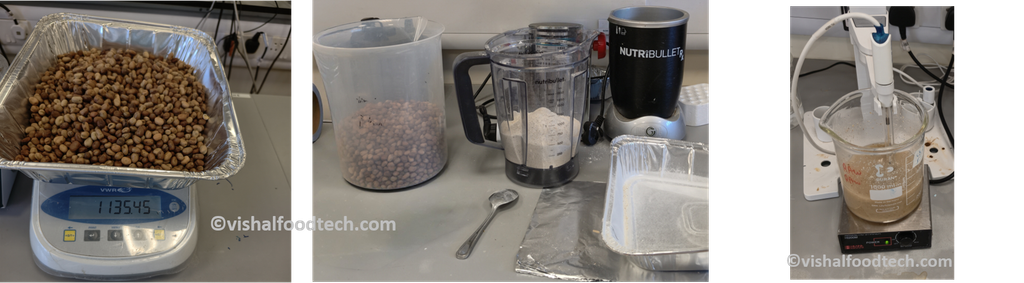
Step 1: Preparing Faba Bean Flour
The process begins with faba beans, which are cleaned and milled into flour.
Milling reduces particle size and increases the surface area available for protein extraction.
The flour may also be sieved to improve particle-size uniformity.
At this point, the product is still bean flour rather than protein isolate.
Step 2: Dispersing the Flour in Water
The flour is mixed with water to form a suspension.
For example, a laboratory demonstration might use:
- 50 g faba bean flour
- 500 mL distilled water
This corresponds to an illustrative flour-to-water ratio of 1:10 (w/v).
The actual extraction ratio should be selected from a validated method and recorded carefully.
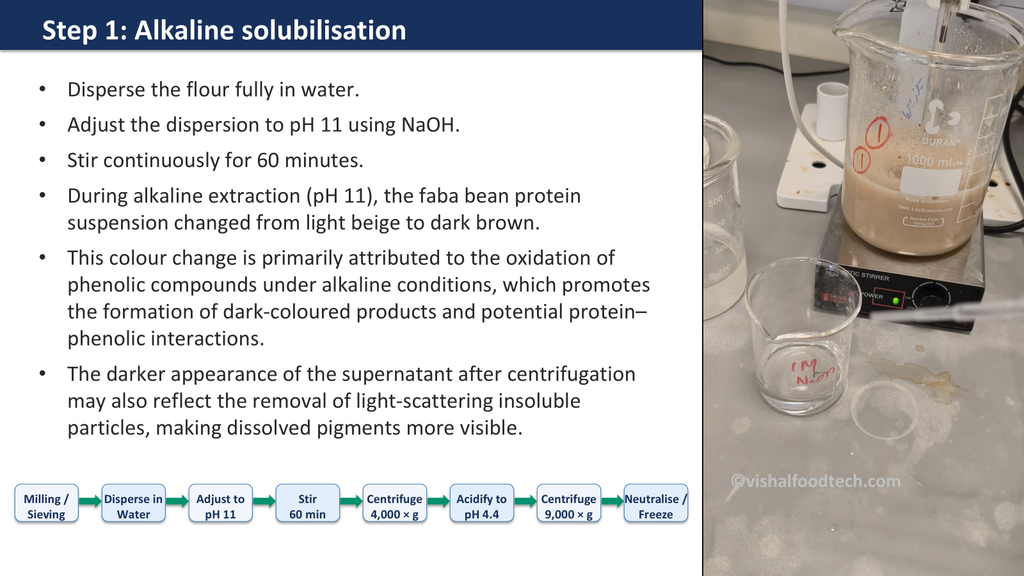
Step 3: Alkaline Protein Extraction
Sodium hydroxide is used to adjust the suspension to alkaline pH in plant protein extraction.
In the demonstrated workflow, the target is pH 11, followed by approximately 60 minutes of stirring.
At alkaline pH, many proteins become more soluble due to changes in their electrical charge and molecular interactions.
As a result, extractable proteins move from the flour particles into the surrounding liquid.
Why Does the Mixture Turn Dark Brown?
An interesting observation during plant protein extraction is the darkening of the suspension under alkaline conditions.
Faba beans naturally contain phenolic compounds. Under alkaline conditions, some of these compounds may oxidise, forming coloured products and potentially interacting with proteins.
This can contribute to a darker protein extract.
Step 4: Separating the Protein-Rich Supernatant in plant protein extraction
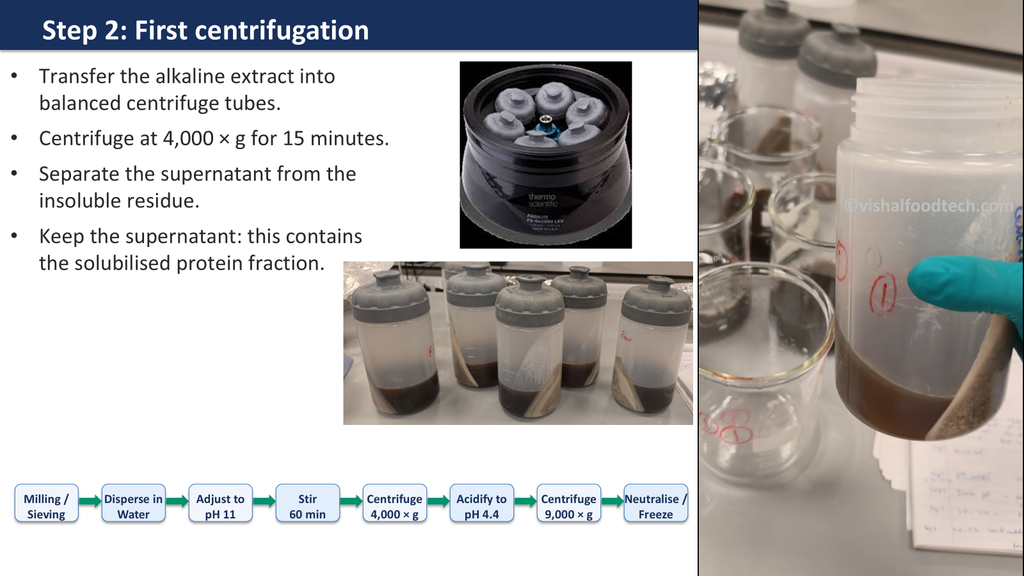
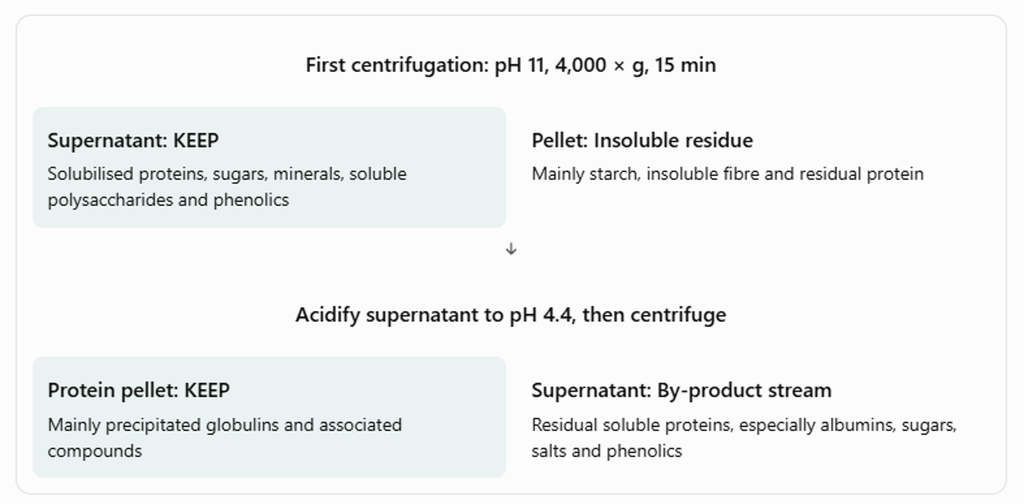
After alkaline extraction, the suspension is centrifuged.
The method discussed in the video uses 4,000 × g for 15 minutes.
Centrifugation separates the mixture into two main fractions.
The supernatant: The upper liquid, containing solubilised proteins together with other dissolved components.
The insoluble pellet: A fraction containing much of the starch, insoluble fibre, cell-wall material and residual unextracted protein.
At this stage, the protein-containing supernatant is retained.
The insoluble residue may also undergo a second extraction to improve protein recovery, depending on the selected protocol.
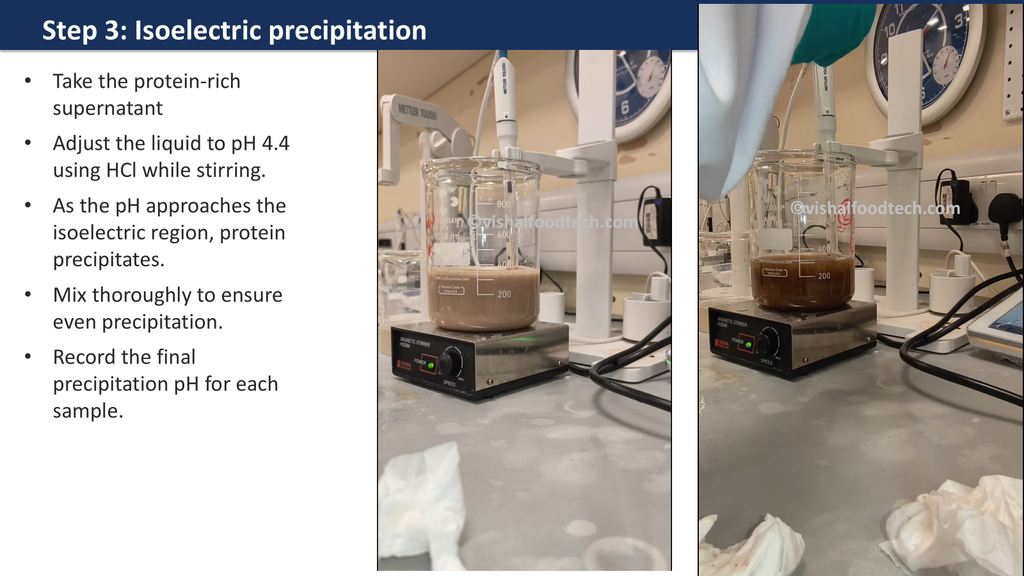
Step 5: Isoelectric Precipitation at pH 4.4
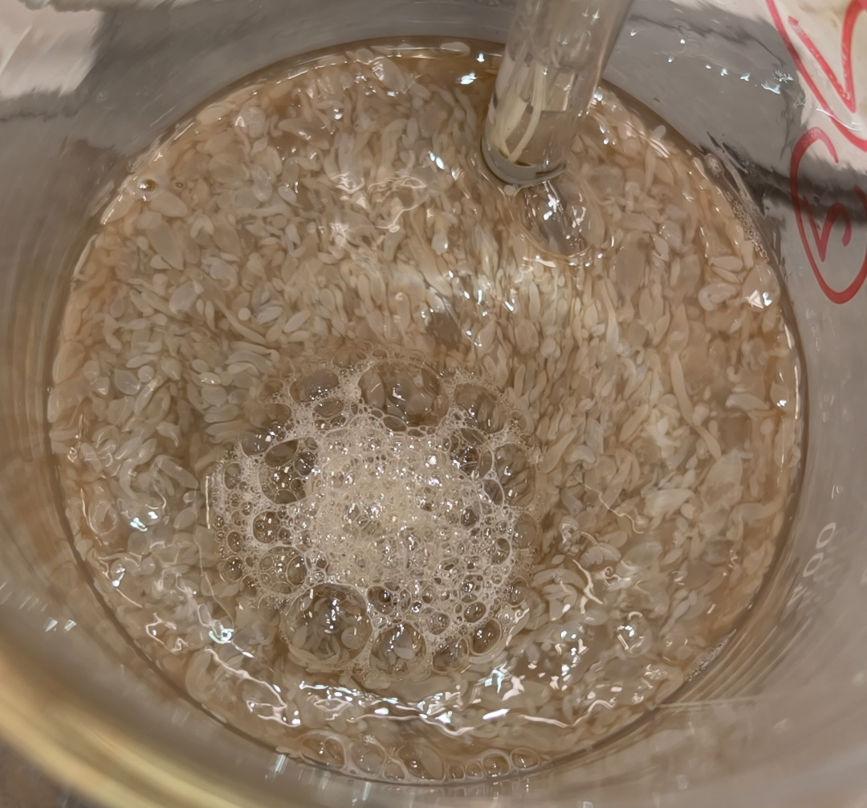
The next step is one of the most visually interesting parts of the process.
Hydrochloric acid is added to reduce the pH of the protein-containing supernatant.
In this laboratory method, the target precipitation pH is approximately 4.4.
As the pH approaches the isoelectric region of major faba bean proteins, electrostatic repulsion decreases.
Proteins can then associate with one another, forming aggregates or flocs that become visible in the liquid during plant protein extraction.
Why Do Rice-Like Protein Flakes Appear?
At alkaline pH, many proteins remain relatively dispersed due to their electrical charge.
When the pH decreases towards the isoelectric point, the net charge approaches zero and electrostatic repulsion is reduced.
Attractive molecular interactions can then promote protein aggregation.
This is why whitish-beige, rice-like flakes may appear during acidification.
These particles are consistent with protein-rich flocs, although visual appearance alone cannot establish their exact composition during the plant protein extraction.
Step 6: Recovering the Precipitated Protein
After precipitation, the mixture is centrifuged again.
The demonstrated method uses 9,000 × g for 20 minutes.
This time, the target protein-rich material is present mainly in the pellet, rather than in the upper liquid.
The pellet is recovered for subsequent processing.
A useful way to remember the difference in plant protein extraction is:
First centrifugation: Keep the supernatant.
Second centrifugation: Keep the protein-rich pellet.
Some soluble proteins may remain in the final supernatant, meaning not all starting protein is recovered.
Step 7: Neutralisation
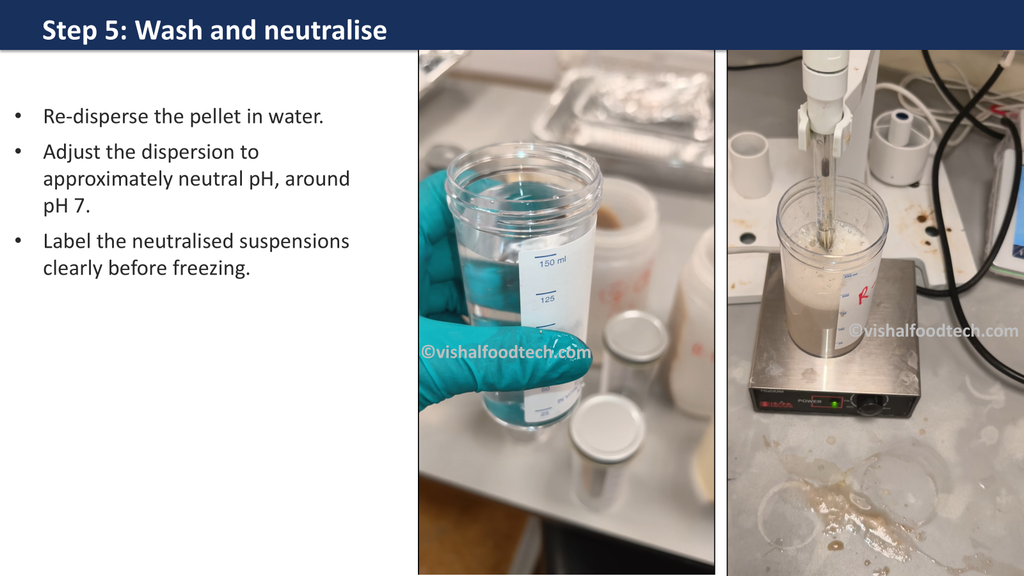
The recovered protein-rich pellet is re-dispersed in water.
Depending on the procedure, washing may also be performed to reduce residual soluble compounds.
The dispersion is then adjusted towards neutral pH, often approximately pH 7.
This prepares the material for subsequent processing and analysis.
Step 8: Freezing and Freeze-Drying
The recovered protein suspension still contains substantial water.
In a freeze-drying process, the material is frozen before water is removed mainly through sublimation under reduced pressure.
This produces a dry protein-rich ingredient that can be weighed, characterised and stored under suitable conditions.
Important: The term protein isolate should be supported by measured protein content. A dry powder does not automatically meet isolate-purity specifications.
How Much Protein Powder Can Be Extracted from Beans?
Plant protein extraction yield depends on the raw material, flour protein content, processing conditions and number of extraction stages.
It is important to distinguish three measurements: mass yield, protein purity and protein recovery.
Example: Calculating Mass Yield
Suppose 50 g of dry bean flour produces 8.5 g of dried protein-rich product after the plant protein extraction.
Mass yield (%) = (Dry product mass / Dry starting flour mass) × 100
Mass yield (%) = (8.5 / 50) × 100 = 17%
The mass yield is 17%.
Example: Calculating Protein Purity
Now suppose the dried product contains 82% protein.
The actual protein present is:
Protein mass = 8.5 × 0.82 = 6.97 g
Therefore:
Protein purity (%) = (6.97 / 8.5) × 100 = 82%
Example: Calculating Protein Recovery
Suppose the original 50 g flour contained 28% protein.
Starting protein mass = 50 × 0.28 = 14 g
The recovered protein mass after the plant protein extraction was 6.97 g.
Protein recovery (%) = (6.97 / 14) × 100 = 49.8%
Therefore, the extraction recovered approximately 49.8% of the original protein in the final product.
These values are hypothetical teaching examples, not measured results from the accompanying demonstration.
Which Protein Extraction Method Is Best?
There is no universally best technique for plant protein extraction.
The most suitable method depends on the intended application.
| Main objective of plant protein extraction | Potentially suitable approach |
|---|---|
| Produce a high-protein isolate | Alkaline extraction–isoelectric precipitation |
| Reduce extensive wet processing | Dry fractionation |
| Use relatively mild extraction conditions | Water or buffered extraction |
| Concentrate soluble proteins | Ultrafiltration |
| Improve protein release from the matrix | Selected enzyme- or physically assisted extraction methods |
| Develop novel processes | Emerging and hybrid extraction technologies |
Alkaline extraction–isoelectric precipitation is a useful conventional reference method for plant protein extraction because it is accessible to many laboratories and can produce protein-rich isolates.
However, it also has limitations, including the consumption of acid and alkali, wastewater generation, possible protein aggregation and changes in ingredient colour or functionality.
Research comparing different faba bean pre-processing methods has shown that protein purity, recovery and functional properties can respond differently to processing conditions.
The best method is therefore the one that delivers the desired balance of purity, recovery, functionality, cost and environmental performance.
Frequently Asked Questions
Can protein powder be made from ordinary beans?
Yes. Beans contain proteins that can be concentrated or isolated through appropriate processing methods of plant protein extraction. However, producing high-purity protein isolate typically requires specialised separation techniques.
Can you make protein isolate at home?
The laboratory procedure described here uses chemical pH adjustment, centrifugation and specialised equipment. It is not a recommended household recipe. Ordinary bean flour is not equivalent to purified protein isolate.
Is plant protein powder the same as whey protein?
No. Plant protein powders are derived from plant materials, while whey protein is obtained from milk. Their protein compositions and functional properties differ.
Why is pH important in protein extraction?
Protein solubility depends partly on electrical charge and molecular interactions. Changing the pH can help solubilise proteins or promote their precipitation.
Why does the protein extract become brown?
Alkaline extraction can promote the extraction and oxidation of phenolic compounds, contributing to darker-coloured extracts. The extent of darkening depends on the raw material and processing conditions.
What is the difference between a protein concentrate and a protein isolate?
A protein isolate generally has a higher protein concentration than a concentrate. Exact classifications depend on the ingredient and applicable definitions.
Does a higher extraction yield mean better protein powder?
Not necessarily. Yield, protein purity, solubility, taste, functionality and nutritional quality must be considered separately.
Is laboratory-extracted plant protein safe to consume?
Laboratory-prepared material should not be assumed suitable for consumption. Food ingredients require appropriate processing controls, compositional assessment and food safety evaluation.
Final Thoughts on plant protein extraction
The process of making plant protein powder involves much more than grinding beans into flour.
Laboratory protein extraction relies on a combination of food chemistry, separation science and careful process control.
By adjusting pH, separating soluble and insoluble fractions, recovering precipitated proteins and drying the final material, researchers can produce protein-rich ingredients from plant sources such as faba beans.
Understanding these principles of plant protein extraction is useful not only for food scientists but also for students, fitness enthusiasts and anyone interested in how modern food ingredients are produced.
Watch the complete laboratory demonstration on Vishal Food Tech and explore the science behind plant protein extraction.
About Vishal Food Tech
Vishal Food Tech explores food science, food processing, plant proteins, plant protein extraction, laboratory methods and emerging food technologies through accessible educational content.
Website: https://vishalfoodtech.com
This article is provided for educational purposes. Laboratory methods must be performed only with appropriate equipment, training and safety procedures.
© VishalFoodTech 2026. All rights reserved for original article and media content.